


Picture a job requisition with 600 applicants. An artificial intelligence screening tool ranks them, flags 450 as weak matches and removes them from the hiring manager’s queue. The manager reviews the remaining 150, interviews eight and makes an offer.
A human made the final decision, but AI decided who had a chance to be considered at all.
Most organizations would describe this process the same way they describe asking AI to draft the job posting: “We use AI in hiring.” The phrase covers both processes, and that is a problem. Drafting a job posting and filtering out three of every four candidates are two very different grants of authority and talent leaders rarely make that grant on purpose.
Talent functions are moving quickly on AI. Teams are training recruiters, piloting skills-matching platforms and adding AI to performance and learning systems. Recruiting is already where HR uses AI most, according to SHRM’s “State of AI in HR 2026.” Those are sensible investments. What tends to get skipped is a governance question, not a technology one: how much authority should AI have over each decision we make about people?
The AI influence ceiling
I use the term AI influence ceiling for the maximum influence an organization is willing to give AI over a particular decision. It helps to place that influence on a continuum:
- Assist: AI helps a person do the work, such as drafting a job description or summarizing interview notes.
- Inform: AI supplies analysis the person weighs, such as skills gaps across a team or labor-market data for a role.
- Recommend: AI proposes an action or a ranking, such as a candidate shortlist or a development plan.
- Determine: AI’s output takes effect unless someone steps in, such as an automatic rejection or an assigned course.
The starting point is the decision—not the tool, the task or the employee. For routine, reversible decisions, a high ceiling may be fine. For decisions that affect someone’s employment, pay or advancement, the ceiling usually sits lower, and someone should set it on purpose.
Capability is not authority
A better AI system should not automatically earn more authority. Neither should a workforce better trained to use it.
A recruiter can become highly skilled with AI sourcing tools without making it appropriate for AI to decide who gets a phone screen. A people analytics team can build an accurate attrition model without turning its risk scores into retention offers. A manager can use AI throughout the review cycle and keep the rating as a human judgment.
I first approached this problem by role. It seemed reasonable that recruiters, HR business partners and managers would need their own set of AI competencies. The more scenarios I worked through, the less that held up. The same HR business partner might reasonably give AI wide latitude drafting a policy FAQ and very little in a termination review. The job hadn’t changed. Her AI skills hadn’t changed; the decision had.
I’ve since tested the idea against decision scenarios in HR, education, research, finance and operations. It’s a management framework, not a validated instrument. But the exercise kept surfacing the same gap: Calling a workforce “AI ready” says a lot about people and very little about how much authority AI should have over any one decision about them.
Mapping ceilings across the talent lifecycle
The same function can need very different ceilings from one decision to the next. Here’s how one organization might draw them:
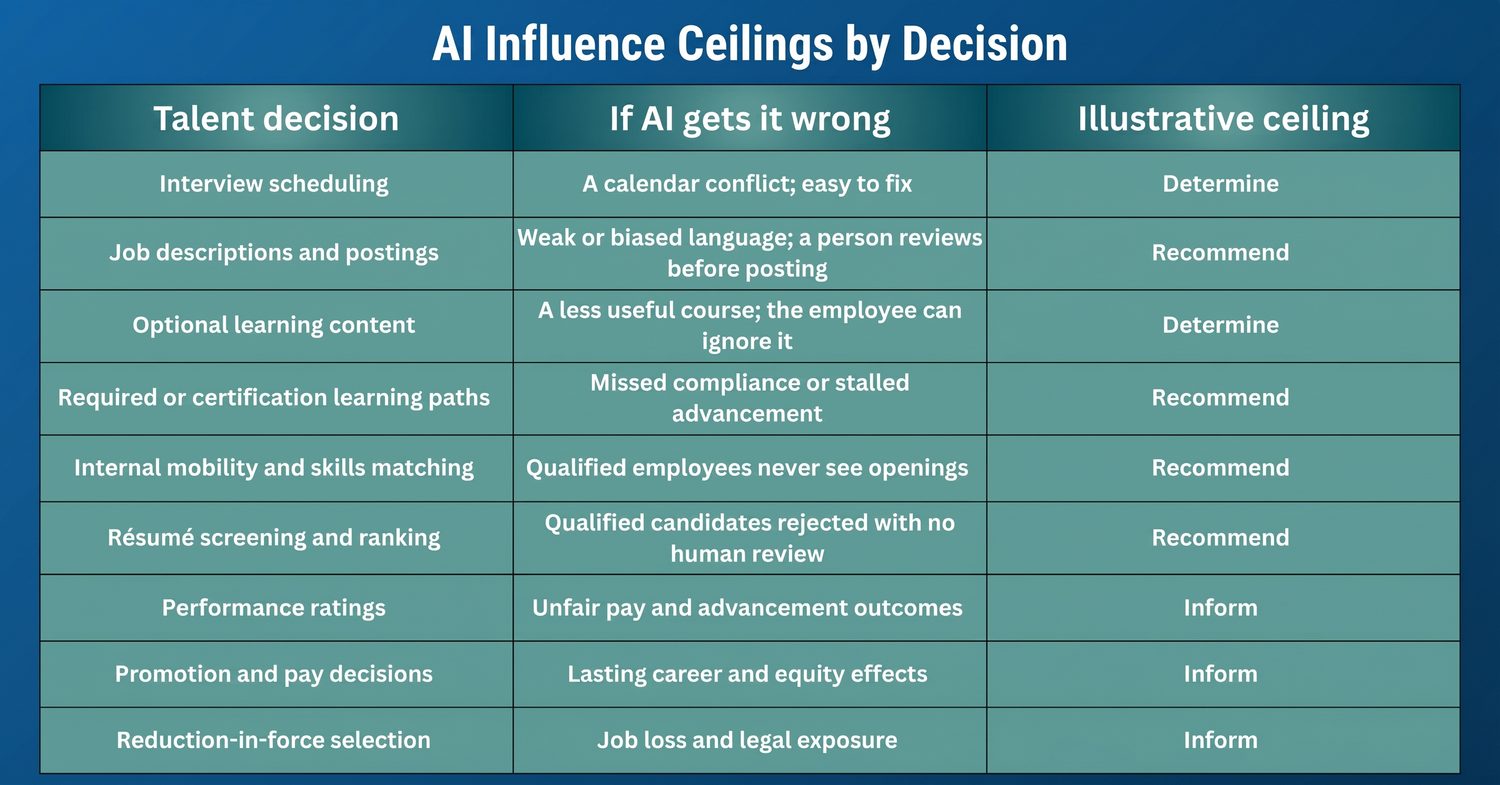
These ceilings are illustrations, not prescriptions. The value is in the exercise: one row per decision, the ceiling written down, and an owner who can defend it.
How ceilings erode
AI rarely gets decision authority in one step. A screening tool starts by summarizing résumés. Then it ranks them. Then someone sets a cutoff so recruiters only see the top quartile, because the volume is overwhelming. Then the cutoff starts sending automatic rejection emails. Nobody approved the move from inform to determine. It happened one configuration change at a time.
That drift is already common. In a 2022 SHRM survey, 64 percent of HR professionals said their automation or AI tools automatically filter out unqualified applicants. And 19 percent of organizations using those tools said they had overlooked or excluded qualified applicants or employees.
Each step looks like efficiency. Together, they produce a process where a human is technically “in the loop” but has little real control. If the model consistently misreads nontraditional career paths, military experience or résumé gaps from caregiving, no one in the process is positioned to notice. The candidates it filtered out don’t appear in anyone’s queue.
Employers already suspect this happens. In Harvard Business School and Accenture’s “Hidden Workers: Untapped Talent” study, 88 percent of employers said qualified high-skilled candidates were screened out because they didn’t match the exact criteria in the job description. For middle-skilled candidates, the figure was 94 percent.
Courts are now asking the same question. In Mobley v. Workday, a federal judge let discrimination claims against a screening vendor proceed on the theory that employers may have delegated the work of rejecting and advancing candidates to its AI. How much automation and decision-making authority the tool held was central to that reasoning. There’s no liability ruling yet, but a nationwide collective of applicants 40 and older was preliminarily certified in 2025. In effect, the court is asking where the ceiling was set.
Talent leaders also can’t count on regulators to draw these lines. Federal agencies pulled their AI employment guidance in 2025, and state rules remain in flux. That makes the ceiling an internal decision, and it’s why vendor defaults and configuration changes should be treated as governance decisions rather than admin settings.
Questions to ask before AI’s role expands
NIST’s AI Risk Management Framework already treats human oversight and accountability as central to managing AI risk. The ceiling turns that principle into a decision a talent leader can make and document.
Before expanding AI’s role in any people decision, ask:
- What decision is AI actually influencing?
- What happens to a person if its judgment is wrong, and would anyone find out?
- Where should the ceiling sit for this decision?
- Can the accountable person independently evaluate and override the AI, including on cases the system filtered out?
- What expertise does that person need to use AI responsibly at that level?
Most talent AI is purchased, so the same discipline belongs in procurement. Ask vendors:
- What is the default authority setting? Does the system rank candidates, or reject them?
- Can reviewers see and search the screened-out pool?
- Can we set the ceiling by decision or requisition type, and is every change logged?
- What evidence do you have on error and adverse-impact rates for populations like ours?
Set the boundary before AI reaches it
Before asking what else AI can do in your talent function, decide which people decisions you’re willing to let it influence, how much influence is appropriate and where it stops. Then build the technology, workflow and training to work inside that line.
The 450 candidates in that opening example never knew a ceiling existed. The organization that screened them should.