



In unstable times, leadership rarely fails because leaders stop moving. More often than not, it fails because leaders respond to one extreme with another.
Institutions drift not when leaders hesitate, but when they overcorrect, substitute force for judgment or confuse visible action with disciplined leadership. The real leadership challenge is to keep purpose, power and performance in proportion so the organization can move forward with legitimacy, clarity and endurance.
That challenge is intensified by the paradox of choice. Leaders are often surrounded by more options, data streams, stakeholder demands and strategic alternatives than they can productively absorb. When everything appears possible and urgent, choice can create the illusion of control while weakening the discipline to decide what is institutionally necessary. In pendulum terms, excessive choice widens the swing by increasing tension, weakening the pivot and making decisive movement harder to sustain.
Leadership balance is not a personality trait. It is not a fixed style, a stable temperament or a matter of instinct alone. Balance is contextual. It depends on the degree to which leaders can read and interpret the demands of the moment accurately and then calibrate judgment, behavior and impact without drifting out of proportion. The same behavior can look decisive in one setting and destabilizing in another; empathetic in one context and dismissive in the next. The question is not whether a leader possesses a balanced style in the abstract, but the extent to which leadership fits what the moment actually requires in practice.
A more useful way to think about leadership balance is as a pendulum moving under pressure, continuously pulled by countervailing forces from either side. Not because leadership should remain in motion for its own sake, but because it depends on whether movement stays proportionate to the context.
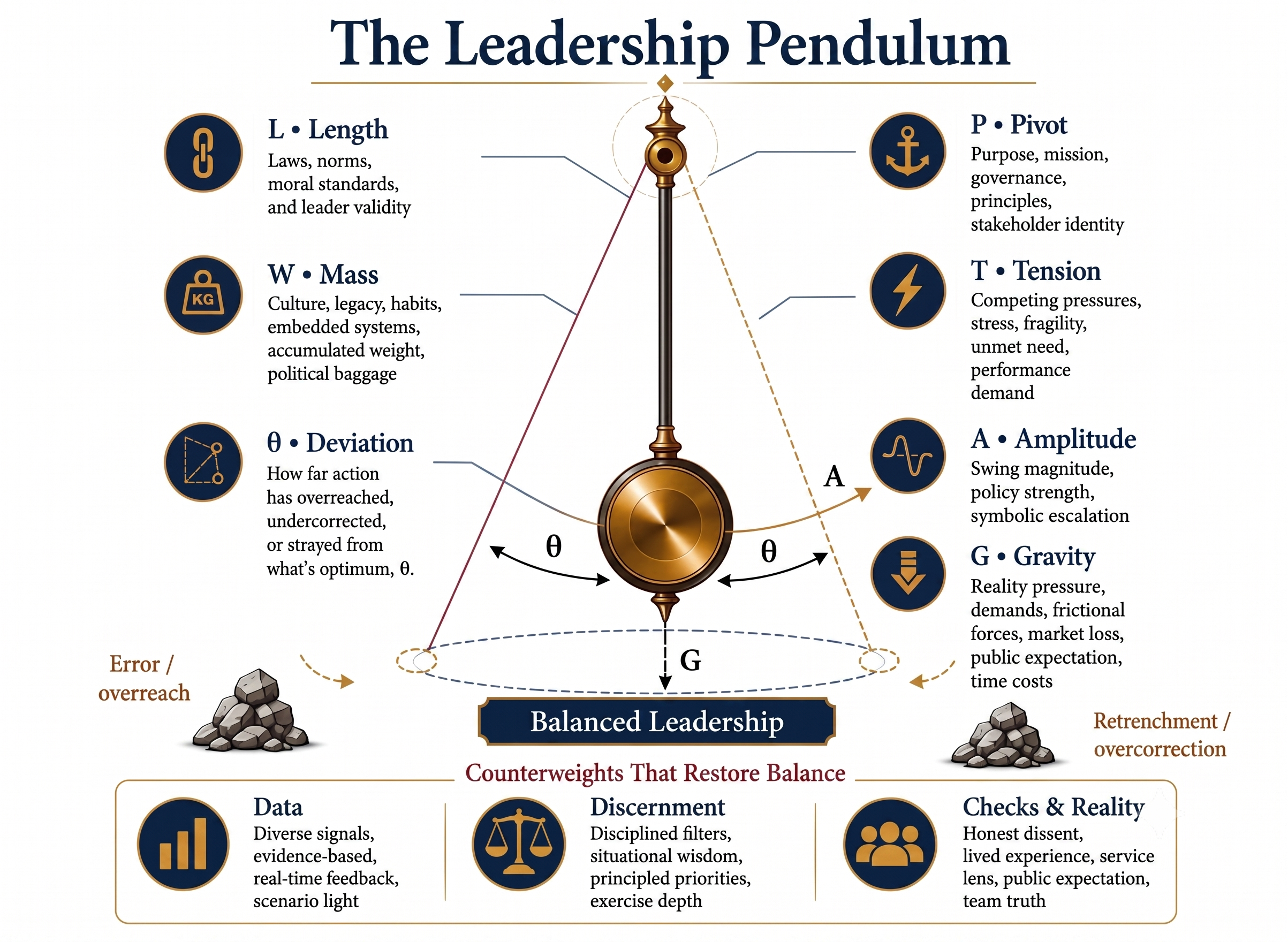
The leadership challenge is to remain anchored in purpose and governance, apply the right amount of force, hold the necessary tension, stay close enough to lived reality to remain relevant and resist swings that create more disruption than progress. Viewed in this way, leadership is not judged only by visible action, but by the mechanics that produce drift, overreach, correction and return.
The leadership pendulum integrated model moves the conversation from metaphor to diagnosis by making tangible and actionable the conditions under which leadership loses proportion: When the anchor weakens, strain accumulates, distance from reality grows, inherited weight goes unexamined, swings widen, reality asserts its pull and stabilizers fail to restore balance.
In that sense, what matters is not simply that leaders act, but that they understand what shapes their actions. Deviation represents the degree to which leadership has moved away from what the moment requires, creating visible misalignment between intention, action and institutional need.
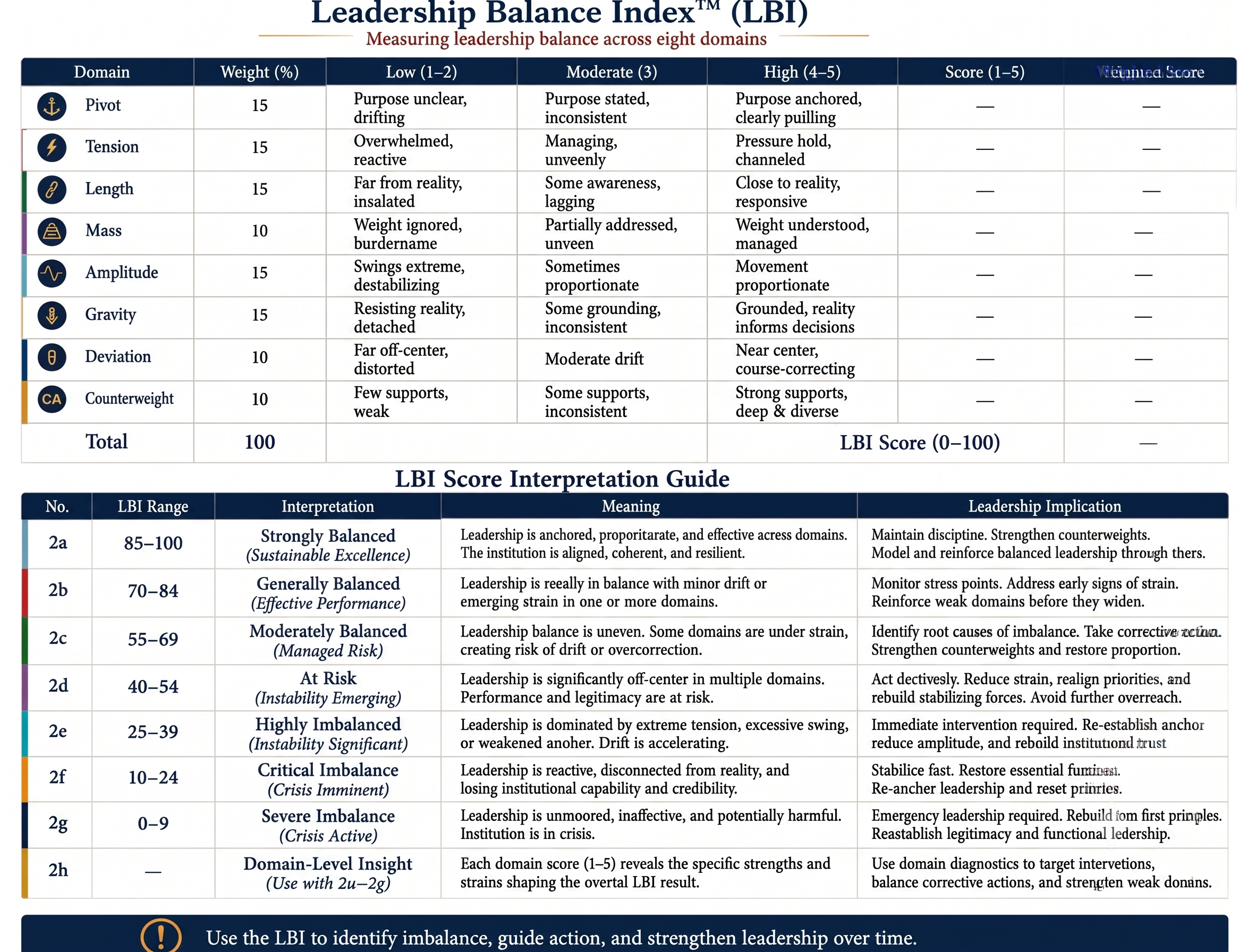
To make the diagnostic more concrete, the model can also be interpreted quantitatively through a leadership balance index. Leadership balance is too easily reduced to impression, personality or stylistic preference. Introducing disciplined measures into the framework provides a more rigorous way to assess whether leadership is actually proportionate to context, and shows which forces are stabilizing the institution and which are pushing it away from center.
In practice, the LBI is not a substitute for judgment. It is an analytic tool for understanding whether leadership is being anchored by mission, corrected by reality and supported by counterweights, or weakened by strain, distance, accumulated weight, widening deviation and widening swings. Used well, it helps leaders move from impression to evidence and from intuition alone to more disciplined assessment.
At the center of the model are three core leadership forces: purpose, power and performance. Purpose is the moral rationale and strategic reason for action. Power is the capacity to decide, direct, allocate and influence. Performance is the disciplined execution that turns intention into results. These forces are expressed in practice through judgment, behavior and institutional impact. Purpose guides judgment, power drives behavior and performance produces institutional impact.
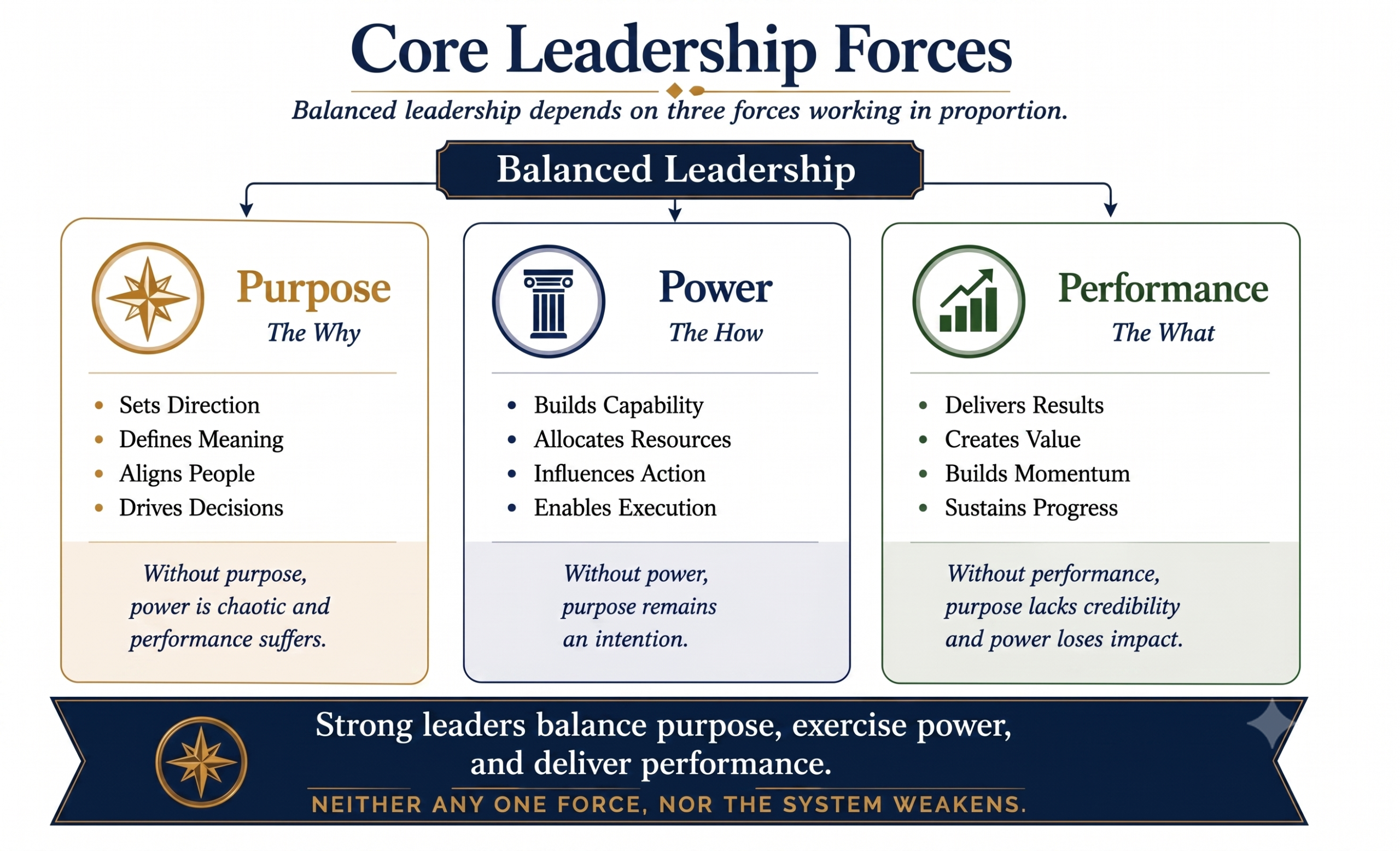
When purpose, power and performance remain in proportion, leadership has legitimacy, traction and coherence. You are now equipped with three new tools: The core forces that show what balanced leadership involves, the pendulum that explains what shapes or distorts it and the LBI that helps assess whether that balance is being sustained in practice.
Using the leadership pendulum
The value of the leadership pendulum is not only that it names the domains of leadership balance, but that it helps leaders diagnose drift before it becomes damage. The domains reveal whether leadership is anchored, strained, distant from reality, burdened by institutional weight, swinging too far or operating without the counterweights needed to restore proportion. The point is not to admire the model’s parts in isolation. It is to use them together to assess whether leadership fits the moment.
The model connects three levels of leadership diagnosis. The three core leadership forces— purpose, power and performance—define what must remain in proportion for leadership to retain legitimacy, traction, and coherence.
The leadership pendulum domains explain what shapes or distorts that proportion in practice: whether leadership is anchored, strained, distant from reality, burdened by inherited weight, swinging too far, corrected by real-world constraints or drifting off center. The practical outcome patterns show the result. When the forces remain balanced and the domains are well managed, leadership is centered. When strain, distance, inherited weight, excessive optionality or weak counterweights begin to pull judgment away from what the moment requires, leadership drifts. When that drift goes uncorrected, leadership becomes distorted through overreach, retrenchment, reactive correction, or symbolic action that weakens legitimacy, trust or results.
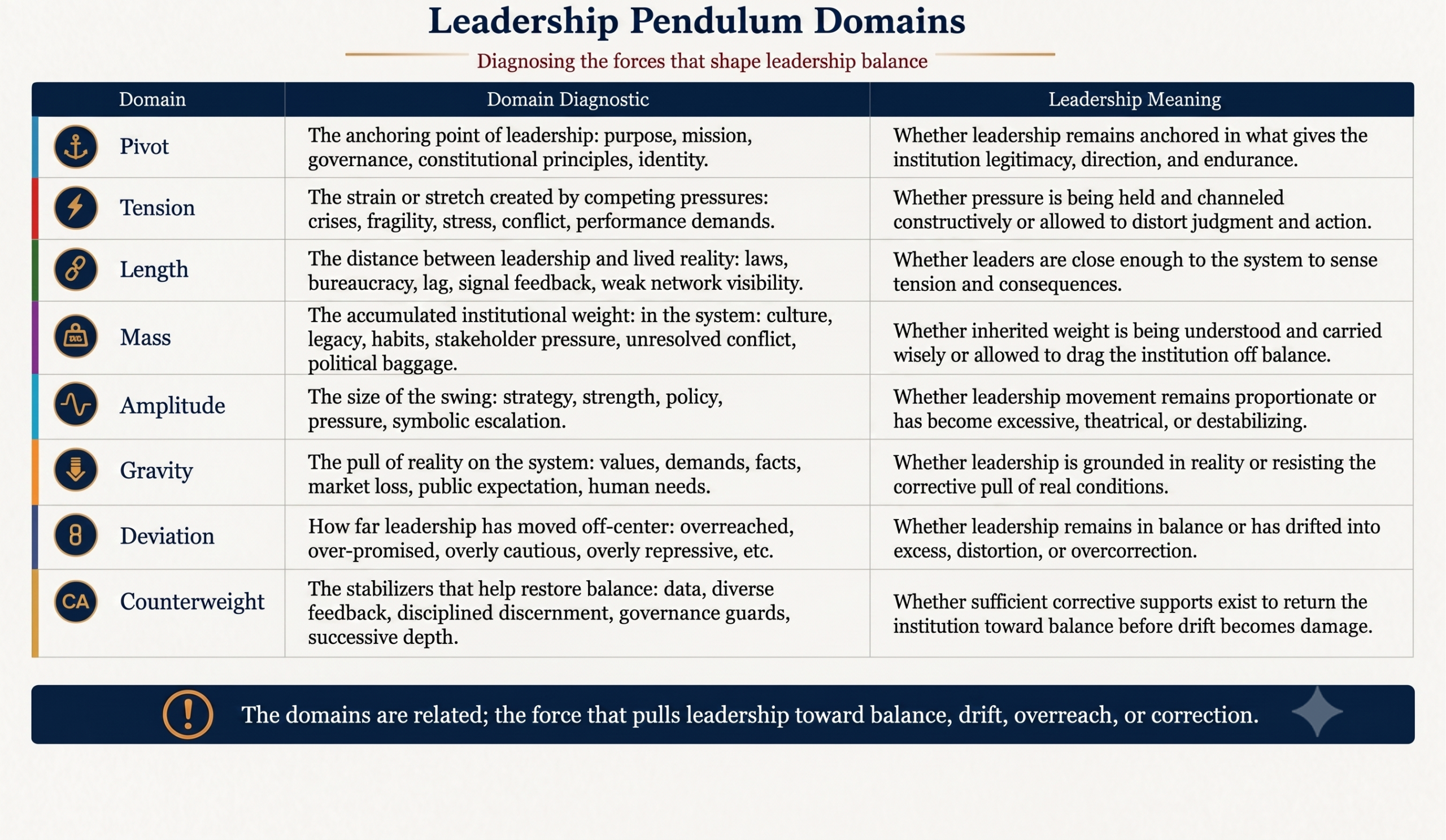
In practice, leaders can begin with a small set of judgments. What is anchoring us right now: mission and governance, or pressure and reaction? Where is strain building? How far have decision-makers drifted from lived reality? What inherited weight is shaping the present moment? What realities are already correcting aspiration? And what counterweights are strong enough to prevent overreach or overcorrection? Over time, those questions can be translated into more disciplined measures that strengthen the LBI and reduce reliance on intuition alone.
Why balance matters
Balance matters because leadership failure is often systemic before it becomes personal. Institutions drift when purpose, power and performance fall out of proportion inside systems already strained by weak anchors, hidden tension, structural distance, accumulated weight, widening swings, and inadequate counterweights. The value of the Leadership Pendulum framework is that it shifts attention away from style, charisma, or executive presence alone and toward a more disciplined assessment of what is actually shaping leadership in practice.
The paradox of choice makes this imbalance more likely because abundant options can widen the leadership swing. Without a strong pivot, leaders may confuse optionality with strategy, add initiatives rather than make trade-offs, and recalibrate so often that the system loses confidence in what matters most.
The model sharpens diagnosis through seven leadership domains: pivot, tension, length, mass, amplitude, gravity, and deviation, alongside counterweights that stabilize the system. Together, these domains help leaders distinguish structural imbalance from temporary turbulence and assess how pressure, excessive optionality and competing choices may push leadership out of proportion.
Mathematically, the Leadership Pendulum can be expressed in regression form: Leadership Balance Index = β0 + β1(Pivot) − β2(Tension) − β3(Length) − β4(Mass) − β5(Amplitude) − β6(Gravity) − β7(Deviation) + β8(Counterweights) + ε.
The equation is not meant to imply false precision. Rather, it shows that leadership balance can be assessed through the interaction of stabilizing and destabilizing forces, not reduced to style, charisma or instinct.
The paradox of choice does not sit outside the model as a separate domain. It operates through the model by increasing tension, widening amplitude, weakening pivot and increasing the risk of deviation when leaders cannot distinguish what is merely possible from what is institutionally necessary.
Rebalancing leadership
The clearest demonstration of the leadership pendulum’s value is not whether an individual leader becomes more self-aware. The real test is the extent to which institutions can rebalance without stalling, fragmenting or losing credibility. That requires more than reflection. It requires leaders to name the imbalance honestly, reconnect values to operating reality, restore trust without abandoning standards, rebuild decision quality and measure what actually matters.
Balance also depends on leadership muscle memory, the learned capacity to think, decide and act under pressure through patterns strengthened by active and purposeful repetition. In healthy institutions, leaders and teams return toward the center by asking for disconfirming evidence, testing decisions against mission, listening downward as well as upward, surfacing risks early and using governance guardrails before crisis forces them into view. Over time, these become habits that make correction earlier, steadier and less theatrical.
The work of balanced leadership is not to freeze the pendulum in one place. Institutions still need movement, and leaders are the stewards of that motion. Effective leadership still requires energy, adaptation, speed, risk-taking and courage. The discipline of leadership is to keep motion from drifting out of proportion. Leadership endures when purpose, power and performance remain in disciplined tension, and when leaders build the habits and counterweights that help the institution recover its balance before the swing becomes destructive.
Balance is not stillness. It is discipline in motion.