

Over the past few years, I’ve noticed a recurring pattern in conversations about succession planning. Organizations spend significant time identifying high-potential talent, discussing who could step into critical roles, and investing in leadership programs.
Yet when a key position suddenly opens, the conversation often shifts from “Who’s next?” to “Who’s actually ready?”
Those are two very different questions.
The more I’ve reflected on it, the more I believe many organizations don’t have a succession planning problem. They have a leadership readiness problem.
The data suggests this challenge is widespread. According to DDI’s Global Leadership Forecast 2025, 80 percent of organizations still lack confidence in their leadership pipelines. That raises an important question: If organizations are investing heavily in identifying and developing future leaders, why do so few feel confident in the strength of their bench?
In my experience, the challenge isn’t that organizations lack talent. It’s that we’ve become very good at identifying potential and much less intentional about developing readiness.
The leadership readiness gap
Leadership readiness is also contextual. It is not simply whether someone is ready to lead but whether they are ready to lead at the right level, in the right context and through the challenges the organization will require next. A leader may be ready to lead an established team, but not yet ready to lead a transformation, turnaround or period of significant growth. Readiness asks a more specific question: Does this person have the capability, judgment and experience required for what comes next?
To be clear, this isn’t an argument against succession planning. Strong succession planning matters. The question is whether succession planning alone is enough for the complexity leaders face today.
Identifying future leaders and preparing them to succeed are not the same thing. We have become very good at measuring participation, competency and program completion. We need to become equally good at understanding whether someone is genuinely more ready to lead. Closing that gap requires three shifts in thinking.
3 shifts in thinking
1. From potential to readiness. Potential tells us what someone might become. Readiness tells us what they can consistently demonstrate today.
I had the opportunity to work with what many of us would call a high performer. He had every traditional indicator of potential: strong performance, credibility, ambition and deep expertise. On paper, he looked ready and a promotion seemed like the obvious next step. But when the scope changed, the gap became visible. The next role required him to lead through others rather than solve the problem himself, influence at the broader level and perhaps most importantly, measure his own success differently.
The impact was felt quickly. The team struggled. The leader who had once been recognized as a top performer was now struggling too. Over time, I watched some of the confidence and motivation that had helped make him a high potential employee begin to disappear.
That’s the risk when we confuse potential with readiness. A promotion doesn’t close the readiness gap. It exposes it.
The experience changed how I think about succession decisions. Identifying someone as high potential shouldn’t automatically answer the question of whether they’re ready for the next role. It should prompt a different question: What does this person still need to experience, practice and demonstrate before we put them there?
The organization bears some responsibility here. We often frame an unsuccessful promotion as “they weren’t ready” or “they just weren’t successful as a leader.” But if we identified them as high potential, promoted them and only then discovered they couldn’t yet lead through others, there’s a legitimate question about whether our system failed to prepare and assess them before making the move.
When that happens, it’s easy to question the leader. We should also be willing to question the system that declared them ready.
2. From leadership programs to leadership systems. Leadership programs remain an important investment, but programs alone don’t create readiness. Readiness develops through a system. A simple way to think about the cycle is: Succession decisions→ Readiness gaps→ Development experiences→ Observation and feedback→ Reassessment.
If a team member needs to develop big picture thinking, give them work that requires it. If they need to lead through ambiguity, create opportunities to practice that before promotion. Observe what happens, provide feedback, reassess readiness and repeat. Development is no longer happening alongside succession planning; it is actively closing the readiness gaps succession planning identifies.
This is not new. Research reinforces the need for this adjustment. DDI’s report calls for a systematic approach to leadership development, including targeted experiences that allow organizations to understand leadership readiness through “lived performance, not just theoretical assessments.” Yet many organizations still invest disproportionately in formal programs while underinvesting in the systems that help leaders apply, practice and reinforce what they’ve learned.
This is the shift we need to make. The question isn’t whether our leadership programs are good enough. It’s whether our leadership systems are strong enough to sustain growth long after the program ends.
3. From measuring participation to measuring readiness. Attendance is easy to measure. Readiness is harder but far more valuable. One question has stuck with me throughout my career, and it’s one I now find myself asking regularly: “What value are you adding?”
Early in my time at BDO Canada, our Chief Learning and Development Officer Dr. Keith Keating, repeatedly challenged our team with that same deceptively simple question. It wasn’t asked as a performance metric, but as a mindset. Over time, it changed how we thought about our work, including how we measured leadership development.
The more I heard it, the more I realized it applies just as much to leadership development as it does to business strategy. If we are investing in leadership programs, we should be asking the same question. What value are they adding? Are they changing how leaders think, behave and develop others, or are we simply getting better at measuring activity?
These questions fundamentally changed how we began thinking about measurement within our Talent Development function at BDO Canada. We began thinking about measurement as a progression: Activity → Capability → Behavior → Impact.
Instead of focusing on standard activity metrics such as “How many people attended?” or “How many learning hours did we deliver?” we stepped back and started again from a different mindset entirely.
We started looking beyond activity to the evidence that helps us understand readiness: Are leaders more capable of having difficult conversations? Are they applying those skills when it matters? Do their teams experience the difference? Those questions are not always easy to answer. They require follow-up, partnership with the business, and a willingness to look at the evidence that doesn’t fit neatly into a dashboard. But they get us much closer to understanding whether leadership development is building readiness or simply creative activity.
Ultimately, it’s not about who attended. It’s about what they do differently next Monday because of it.
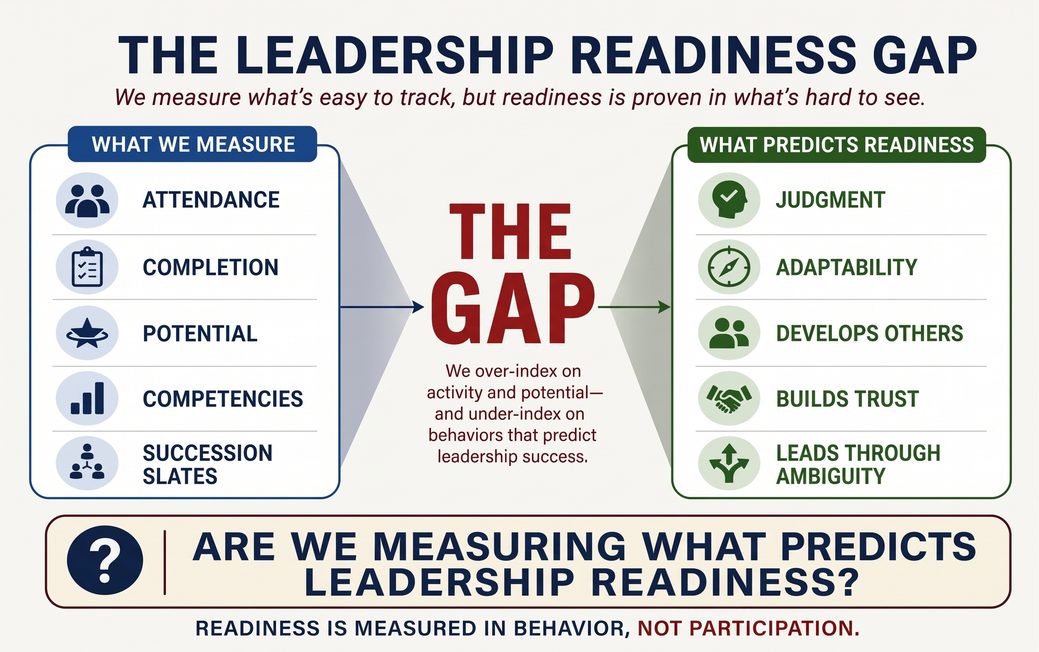
Note. Conceptual framework developed by KayLee Hansen. Figure created by the author.
Closing challenge
The question isn’t simply, “Who could step into the next role?” It’s, “Are they ready for what comes next and what evidence do we have?”
Leadership readiness isn’t something organizations discover during succession planning. It’s something they build and observe every single day. If we want stronger succession pipelines, we need to spend less time asking, “Who’s next?” and more time building the evidence to answer, “Who’s actually ready?”