

Every January, millions of people set New Year’s resolutions focused on getting a promotion, changing careers or finding a new job.
But what happens next? These resolutions are just outcomes, and rarely do they include the first actionable step. People only reach their career goals if they know the skills they need first.
Organizations often respond to stagnation with more training, but the underlying challenge is not one-size-fits-all. Some employees need new capabilities to reach the next level, while others may need a clearer direction or more opportunities to apply and demonstrate existing skills.
For talent leaders, accurately identifying these barriers is essential to being able to meaningfully develop, retain and advance employees.
What the data shows
Whether the goal is a new job or a promotion, we discovered from our own feedback that the first step is identifying what’s truly in the way.
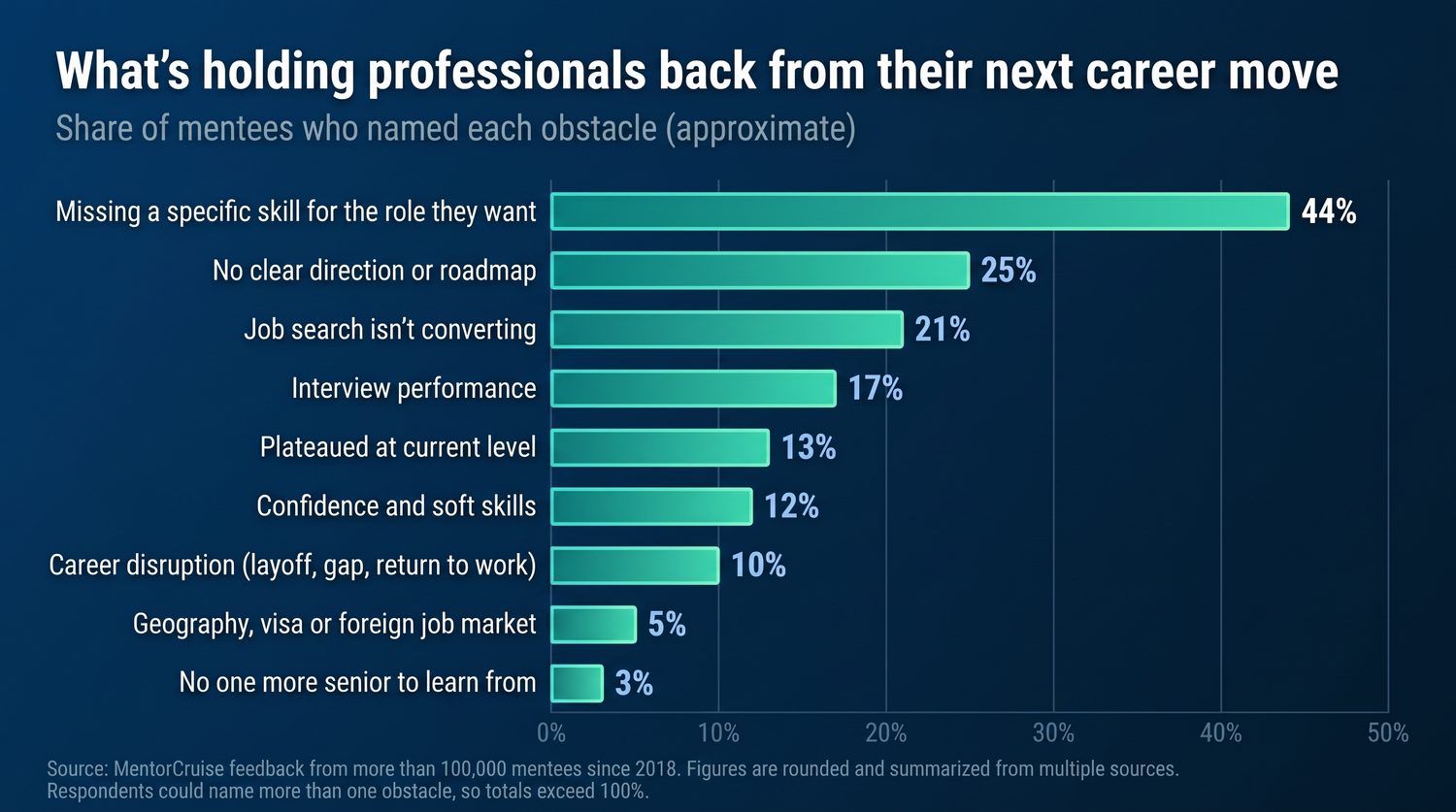
At MentorCruise, a marketplace that pairs professionals with experienced practitioners for ongoing one-on-one mentorship, we have collected feedback from more than 100,000 mentees since 2018. Among those who cited an obstacle, about 44 percent said they were missing a specific skill for the role they wanted. Another 25 percent or so said they didn’t know where to start.
From wish list to skill set
Closing the gap on a career move takes three steps: pinpointing the skill, regular practice and feedback from a direct manager who has a clear view of their progress over time.
For example, for a senior software engineer whose goal is to become an engineering manager, the first step is finding out what managers at that level do every week: On many engineering teams, a big part of the job is turning a vague product request into a plan the team can build. More managers are using artificial intelligence tools to draft those plans and to summarize what the team ultimately ships.
With the skill identified—in this case, how to put the plan together using AI for the first draft—the engineer can practice it by volunteering to scope the next small feature and compare it with what actually ships. Every couple of weeks, a manager who already plans this way can review the work and point out progress or inconsistencies.
Helping employees find the real gap
Start with the desired role and work backward. Instead of looking at the job description, look at their calendar. What do people actually do every week? How is it different from their desired role? There is your gap.
In Figure 1, about 44 percent of mentees reported they were missing a skill, and could not do the work they aspired to yet. About 25 percent had a direction gap and didn’t know what role to aim for; 21 percent had a positioning gap, meaning they could do the work, but it wasn’t showing up in applications or interviews.
Each gap needs a different fix. Find someone who has done the role or is actively doing it and ask them to look at work regularly. Having an outside reviewer will help catch what’s hard to see from the inside and fix it before a performance review does.
What L&D teams should do instead of a generic 2027 upskilling list
Most learning and development programs begin by asking the employee which courses they want to take. L&D teams should instead consider the following question as the starting point: What’s standing between the employee and their next career move?
Our survey revealed that responses normally land in three buckets, and need three different solutions: someone missing a skill who needs training, someone who doesn’t have direction and needs guidance and someone who knows how to do the work, but needs help showing it.
Career conversations like that are rare. LinkedIn’s 2025 Workplace Learning Report found that only 15 percent of employees said their manager helped them build a career plan in the last six months. Half of respondents said weak manager support was a top barrier to career development.
Moreover, managers shouldn’t be the only option for feedback. It helps to have experienced practitioners, such as senior leaders, looking at the employee’s work.
Lastly, fund fewer goals. A long list of courses is easy to approve but hard to finish. One skill, one reviewer and a check-in every 90 days will show more results.
Here is some practical advice that results in true growth in 2027: Tell each employee to name a skill they desire, create the space to let them practice it in real time and tap your senior leaders to engage in their development process.