


Every executive knows the frustration.
The strategy was sound. The goals were clearly articulated. The organization invested months developing a strategic plan, communicating priorities and aligning resources. Yet six months later, execution had stalled. Departments were moving in different directions. Meetings generated updates instead of decisions. New initiatives lost momentum before delivering measurable results, and leaders found themselves repeating the same message, wondering why progress remained elusive.
When this happens, we often hear the same explanation: “It’s a culture problem.”
While that diagnosis is common, I believe it is incomplete.
Culture doesn’t execute strategy. People do.
Every day, people make hundreds of decisions that determine if their organization’s strategy becomes reality. They decide how to prioritize competing demands, when to collaborate across teams, whether to raise concerns, how to respond to change and where to focus their time and energy. Collectively, those seemingly ordinary decisions determine whether an organization moves confidently toward its strategic goals—or slowly drifts away from them.
The question, then, is not simply whether an organization has a strong culture. The more important question is whether leaders have created organizational conditions that enable people to consistently make decisions that advance the mission. That distinction changes everything.
For decades, organizational culture has been discussed as a set of shared values, beliefs and norms. Organizations devote significant effort to crafting mission statements, defining core values and articulating the behaviors they hope employees will embrace. These efforts are important, but they often overlook a fundamental reality: Employees experience culture far less through what an organization says than through what an organization consistently does.
Culture reveals itself in how decisions are made. It is reinforced through the priorities leaders establish, the behaviors they recognize, the expectations they communicate and the systems they use to evaluate performance. Edgar Schein and Peter Schein describe culture as the shared assumptions that develop as organizations solve problems together over time—assumptions that do not emerge by accident, but are shaped by leadership decisions and reinforced through organizational systems.
This is why organizations with exceptionally talented people still struggle to execute strategy. Talent alone is rarely the deciding factor. People perform within environments that either support or constrain effective decision-making. When priorities are unclear, ownership is inconsistent, expertise remains isolated or learning is treated as an occasional event rather than an ongoing capability, even the strongest strategies lose momentum.
Conversely, organizations that consistently execute well rarely rely on extraordinary individuals alone. They intentionally create environments where people understand what matters, take ownership for outcomes, contribute their expertise and continuously improve how work gets done. Execution becomes less dependent on heroic leadership and more dependent on organizational capability.
This dynamic isn’t confined to any one sector. Whether the setting is a corporate change initiative, a new learning platform rollout, or an institution redesigning how it delivers instruction, the pattern holds: Strategy stalls not when people lack commitment, but because the organization hasn’t built the conditions for good decisions to happen consistently.
Today, this distinction has become even more significant as artificial intelligence has transformed the way we work. Yet, while technology continues to evolve, the critical challenge leaders face remains remarkably consistent: They must continue to champion an organizational culture where people can perform at their highest potential while advancing the shared mission.
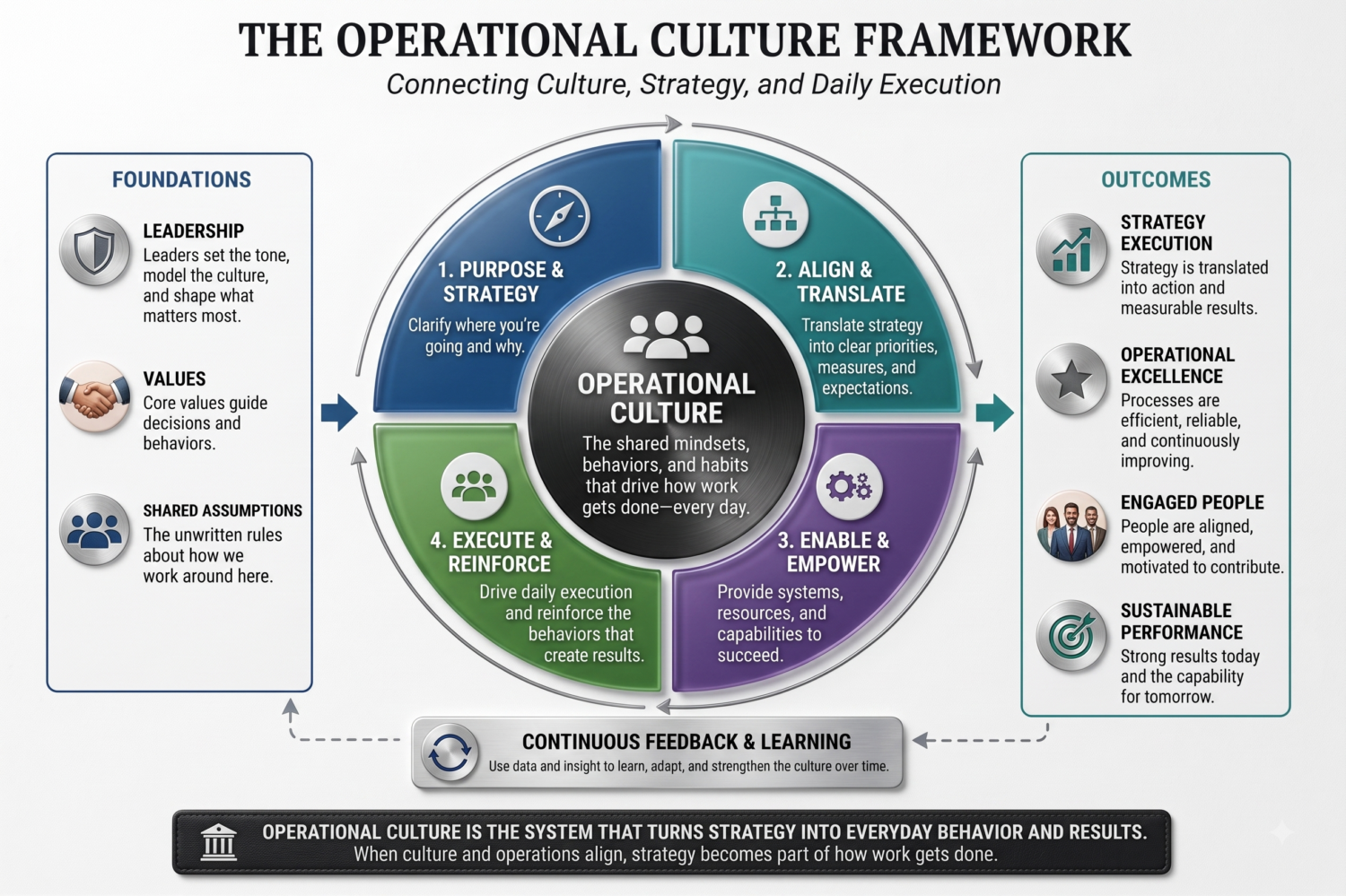
Moreover, rather than viewing culture as an outcome of organizational success, leaders should begin to see it as an operational capability—one that can be intentionally designed, strengthened and continuously refined. I refer to this leadership approach as the operational culture framework, built around four capabilities: clarity, accountability, collective intelligence and adaptability. These will be unpacked below.
The organizations that will thrive in the coming decade won’t necessarily be those with the most ambitious strategic plans or the most sophisticated technologies. They will be those whose leaders understand that strategy succeeds only when people have the conditions to execute it—consistently, collaboratively and with purpose.
Leadership’s forgotten responsibility
If people execute strategy, then leadership’s most important responsibility extends beyond setting direction. Leaders must create the conditions that enable people to make decisions aligned with the organization’s mission.
This responsibility is often overlooked because culture has become synonymous with values statements, employee engagement initiatives or workplace perks. Organizations proudly display their mission on conference room walls, publish behavioral expectations on their websites and invest significant time defining the culture they aspire to create. Yet employees rarely experience culture through written statements. They experience it through the systems that shape their work every day.
Consider what happens during a typical week inside any organization. A new employee observes how decisions are made in leadership meetings. A manager recognizes one team member’s performance while overlooking another’s. Departments compete for resources. A supervisor responds to a mistake. A cross-functional project succeeds—or stalls—because communication breaks down.
Each interaction teaches employees something about how the organization actually operates. Over time, these experiences become far more influential than any list of organizational values because they establish the unwritten rules that guide everyday behavior. This is where leadership has the greatest influence. And whether intentional or not, leaders continuously shape culture through the expectations they establish, the behaviors they reinforce, the questions they ask, the decisions they reward and the systems they choose to build.
This perspective also explains why organizations with similar strategies often achieve dramatically different results. Two organizations may articulate nearly identical missions, invest in comparable technology and employ equally talented people. Yet one consistently executes while the other struggles to gain traction. The difference is rarely the strategy itself. More often, it is the operating environment leaders have created to support—or hinder—execution.
High-performing organizations do not leave this environment to chance. They intentionally design it. They recognize that every organizational system sends a message. Performance evaluations communicate what success looks like. Team meetings establish how decisions are made. Professional development signals what capabilities are valued. Recognition programs reinforce desired behaviors. Individually, these may appear to be routine management activities. Collectively, they define how strategy comes to life.
This requires a subtle but important shift in how leaders think about culture. Instead of asking, “How do we improve our culture?” leaders should begin asking, “What conditions are we creating that help people succeed?”
That question changes the conversation. Rather than focusing on abstract concepts, leaders begin examining the systems that influence everyday work: Are priorities consistently communicated? Do employees understand how their work contributes to organizational goals? Are decisions made by the people closest to the work, or do unnecessary layers of approval slow progress? Do teams collaborate across organizational boundaries, or do functional silos limit innovation? Does the organization learn from both successes and setbacks, or does it simply move on to the next initiative?
In my work with faculty, academic leaders and organizations navigating digital transformation, I’ve observed that sustainable improvement rarely comes from launching another initiative. It comes from strengthening the conditions that allow people to perform at their best.
I saw this play out during a course-redesign initiative where instructional designers were tasked with helping faculty meet new quality expectations. The IDs believed they had the information they needed and moved forward building support materials largely on their own, without working directly alongside faculty to confirm what those expectations actually required in practice. The output didn’t match what faculty needed to succeed, and faculty began experiencing instructional designers less as partners and more as a compliance checkpoint.
Once we clarified what faculty actually needed to deliver—and what meaningful support from instructional design was supposed to look like—the relationship changed. Instructional designers shifted from enforcing a requirement to helping faculty meet a shared goal, and the redesign work itself moved faster, because both sides were finally solving the same problem instead of working past each other.
That experience is one of several that led me to develop the operational culture framework.
4 capabilities that turn strategy into execution
Organizations that consistently execute strategy rarely do so because they have better plans. More often, they have developed organizational capabilities that enable people to make sound decisions, work effectively together and respond to change without losing sight of their purpose.
The scale of the gap is well documented. In their original research on strategy execution, Kaplan and Norton argued that as many as 90 percent of organizations fail to execute their strategies successfully, largely because they are unable to translate strategic objectives into coordinated day-to-day action throughout the organization. That’s the gap this framework is built to close.
The operational culture framework centers on four capabilities:
Clarity provides direction. People perform best when they understand what success looks like, how priorities are established, and how their work contributes to the organization’s mission. Clarity reduces uncertainty and enables better decision-making throughout the organization.
Accountability transforms expectations into ownership. Rather than relying on compliance, effective leaders establish clear responsibilities, provide the authority needed to act, and reinforce shared ownership for results. Accountability becomes part of the organization’s operating rhythm rather than an annual performance discussion.
Collective intelligence recognizes that the best decisions rarely come from a single leader. Organizations improve performance when they intentionally leverage the expertise of people across functions and create real structures for surfacing dissent and expertise—not just an open-door policy. That kind of structure depends on psychological safety: the shared belief that it’s safe to speak up, which is the precondition for collective intelligence to function at all.
Adaptability ensures organizations continue learning as conditions evolve. Adaptability is not simply responding to change; it is building an organization capable of learning faster than change occurs. This is close to the distinction John Kotter draws between managing change as a one-time event and building an organization structured for continuous change—the latter is what sustains adaptability over time.
Kodak is the case every business audience already knows, and it makes its point precisely: The company’s own engineers invented the digital camera in 1975, decades before the market forced the issue. Kodak didn’t lack the information or the technology. It lacked the organizational capability to act on what it already knew, because doing so meant disrupting a highly profitable film business. By the time leadership moved, competitors had already taken the market.
Adaptability isn’t about seeing change coming—most organizations do. It’s about whether the organization is built to act on what it sees.
These capabilities reinforce one another: Clarity strengthens accountability, accountability encourages meaningful contribution, collective intelligence improves organizational learning and adaptability lets the whole system refine itself over time. Together, they create an operational culture where strategy is no longer confined to a strategic plan but is reflected in the decisions people make every day.
5 questions every leader should ask
Before launching another strategic initiative or culture campaign, ask these five questions. Each one maps to a specific capability, so a “no” tells you exactly where to start:
- Do our employees clearly understand what matters most and how success is measured? (Clarity)
- Are responsibility and decision-making authority aligned, or does bureaucracy slow execution? (Accountability)
- Are we intentionally drawing on expertise from across the organization when solving complex problems? (Collective intelligence)
- Have we built regular opportunities for reflection and learning, or do we move from one initiative to the next without evaluating what we’ve learned? (Adaptability)
- Do our everyday systems—meetings, recognition, communication and performance management—reinforce the culture we aspire to create? (All four). Systems are where each capability either takes hold or quietly erodes.
The symptoms usually show up before the diagnosis does:
- Meetings produce updates instead of decisions → clarity gap.
- People wait for permission on problems they’re already positioned to solve → accountability gap.
- The same mistake happens in two departments because no one talked to each other → collective intelligence gap.
- The organization keeps launching the same kind of initiative and getting the same disappointing result → adaptability gap.
Defined as “we have a culture problem,” it stops being an amorphous diagnosis and becomes a specific, addressable one.
Go back to the stalled strategy at the beginning of this article. The plan wasn’t wrong;the people weren’t the problem.
What was missing was the operational infrastructure—the clarity, accountability, collective intelligence and adaptability—that turns a strategic plan into thousands of good decisions, made every day, by people who understand what they’re building toward.
That infrastructure isn’t a soft add-on to strategy. It’s the mechanism by which strategy becomes real.